
For the past five years, the Wellesley Centers for Women and its home at Cheever House have been my space for taking a deep breath, a place I felt at peace. It gave my heart permission to feel free, allowing the quietness of the environment to slide into my skin, to think and comprehend. It has been a blessing that arose in the most wonderful disguise, working with Senior Research Scientist Wendy Wagner Robeson, Ed.D., and her student interns, growing ideas, failing and succeeding, learning from mistakes, misfortunes, or failures that turned into opportunities.
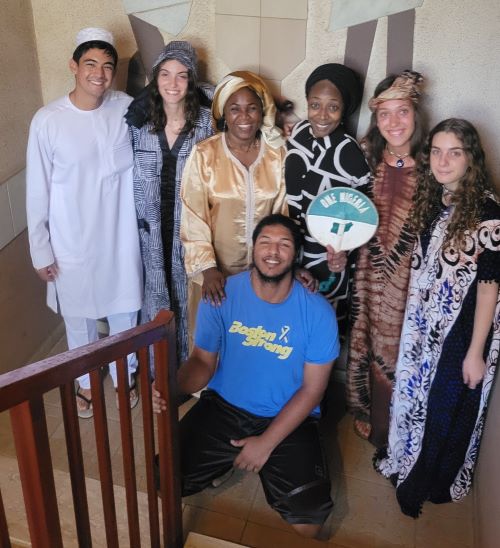 The 2024 STEAM camps tutors, their host Hon. Adedayo Benjamins-Laniyi, and Ibrahim, at her house in Abuja, Nigeria in July 2024.
Our first science, technology, engineering, art, and mathematics (STEAM) camps, in 2019, gave us opportunities to learn and grow. We brought STEAM kits that included measuring tapes, pipettes, sand timers, test tubes, strings, boxes, and bouncy balls, as well as local materials and products, into communities in Nigeria to teach students STEAM. This has become my passion. A lawyer by vocation, a visiting professor by choice, I found myself in elementary and high school classes ready to learn science in order to be effective in the field with children like I was at that age, 10 to 15—powerless, voiceless, poor, and illiterate.
Fulfilling a dream—I wanted the children to have what I did not have, and so I immersed myself. If I could go from hawking any saleable goods in my village to teaching at Harvard University, then those children could realize their potential to be even better than me. This is also in line with the Convention on the Rights of the Child, Article 31, which states that children of all ages have the right to access and fully participate in cultural and artistic life.
Over the next five years, Dr. Robeson and the Wellesley Centers for Women supplied some of those items for our STEAM camps in Nigeria. It was important to me to ensure that whoever, whatever will add value to my dream was not beyond my reach. For the most part, we did not have the resources, but it never stopped the camps. I acknowledge with gratitude the generous donations from First Parish in Lincoln, Massachusetts. In addition, the director of the University of Rome, Tor, Vergata, Italy, has been instrumental to the work in Nigeria, allowing students from the university to be tutors.
Generally, the students from the University of Rome or elsewhere buy their plane tickets and I provide accommodations, food, and security, with the help of governmental agencies in Nigeria. Students chosen to go must have the ability to adapt, be patient, have empathy for others, possess a nurturing instinct, and be able to be flexible.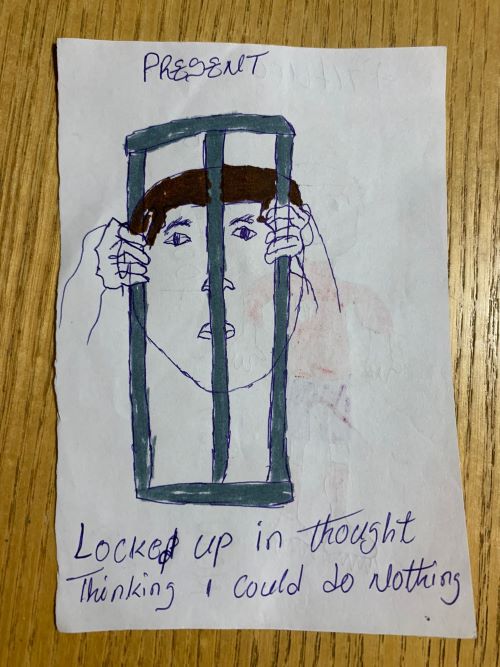 A drawing by a student from one of the 2024 STEAM camps.
Our previous camps were successful, but the 2024 STEAM camps were exceptional, a game changer. In addition to working with children, we also were able to train teachers from schools and other organizations to continue what we did in the camps.
This past summer we were able to work with children from orphanages, children with disabilities, and others. Our five tutors at the 2024 STEAM camps were Matilde Belleggia, Anna Cascarino, David Marulanda, and Angelica Felici Caravella, all from the University of Rome, Tor, Vergata, Italy, and Silvio Dionisotti from the U.S. These tutors provided intrinsic motivation, enjoyment, and positive attitudes, helped with cognitive problem-solving and self-discipline, developed tools for communication and meaning-making, and fostered creativity and imagination for the children whose communities participated around Abuja, Nigeria and beyond.
Our art teacher, Angelica, was creative in her approach to teaching. She asked the children to draw themselves now, and what they want to be in the future. One of my favorites was the drawing that said, “now I feel I am in a cage, but in the future, I want to be a footballer.” Another was an answer from a pupil that is full of food for thought: In answer to the question of what she wants to be in life, she said “a white girl.” The idea of being white could be a rejection of who she is and that may hinder a few things as she grows up. I told her what matters is the content of her character and not the color of her skin.
The art classes led to the publication of The Children's Artwork, from 2024, Science, Technology, Engineering, Arts and Mathematics' (STEAM) Camps, published by the University of Rome Press in January 2025.
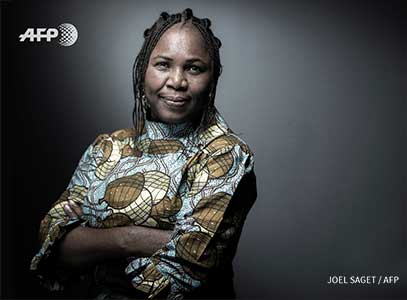
Hauwa Ibrahim is a Senior International Scholar-in-Residence at the Wellesley Centers for Women. She is an international human rights and Shariah law attorney with significant academic and government experience.
The 2024 STEAM camps tutors, their host Hon. Adedayo Benjamins-Laniyi, and Ibrahim, at her house in Abuja, Nigeria in July 2024.Our first science, technology, engineering, art, and mathematics (STEAM) camps, in 2019, gave us opportunities to learn and grow. We brought STEAM kits that included measuring tapes, pipettes, sand timers, test tubes, strings, boxes, and bouncy balls, as well as local materials and products, into communities in Nigeria to teach students STEAM. This has become my passion. A lawyer by vocation, a visiting professor by choice, I found myself in elementary and high school classes ready to learn science in order to be effective in the field with children like I was at that age, 10 to 15—powerless, voiceless, poor, and illiterate.
Fulfilling a dream—I wanted the children to have what I did not have, and so I immersed myself. If I could go from hawking any saleable goods in my village to teaching at Harvard University, then those children could realize their potential to be even better than me. This is also in line with the Convention on the Rights of the Child, Article 31, which states that children of all ages have the right to access and fully participate in cultural and artistic life.
Over the next five years, Dr. Robeson and the Wellesley Centers for Women supplied some of those items for our STEAM camps in Nigeria. It was important to me to ensure that whoever, whatever will add value to my dream was not beyond my reach. For the most part, we did not have the resources, but it never stopped the camps. I acknowledge with gratitude the generous donations from First Parish in Lincoln, Massachusetts. In addition, the director of the University of Rome, Tor, Vergata, Italy, has been instrumental to the work in Nigeria, allowing students from the university to be tutors.
Generally, the students from the University of Rome or elsewhere buy their plane tickets and I provide accommodations, food, and security, with the help of governmental agencies in Nigeria. Students chosen to go must have the ability to adapt, be patient, have empathy for others, possess a nurturing instinct, and be able to be flexible.
A drawing by a student from one of the 2024 STEAM camps.Our previous camps were successful, but the 2024 STEAM camps were exceptional, a game changer. In addition to working with children, we also were able to train teachers from schools and other organizations to continue what we did in the camps.
This past summer we were able to work with children from orphanages, children with disabilities, and others. Our five tutors at the 2024 STEAM camps were Matilde Belleggia, Anna Cascarino, David Marulanda, and Angelica Felici Caravella, all from the University of Rome, Tor, Vergata, Italy, and Silvio Dionisotti from the U.S. These tutors provided intrinsic motivation, enjoyment, and positive attitudes, helped with cognitive problem-solving and self-discipline, developed tools for communication and meaning-making, and fostered creativity and imagination for the children whose communities participated around Abuja, Nigeria and beyond.
Our art teacher, Angelica, was creative in her approach to teaching. She asked the children to draw themselves now, and what they want to be in the future. One of my favorites was the drawing that said, “now I feel I am in a cage, but in the future, I want to be a footballer.” Another was an answer from a pupil that is full of food for thought: In answer to the question of what she wants to be in life, she said “a white girl.” The idea of being white could be a rejection of who she is and that may hinder a few things as she grows up. I told her what matters is the content of her character and not the color of her skin.
The art classes led to the publication of The Children's Artwork, from 2024, Science, Technology, Engineering, Arts and Mathematics' (STEAM) Camps, published by the University of Rome Press in January 2025.
Hauwa Ibrahim is a Senior International Scholar-in-Residence at the Wellesley Centers for Women. She is an international human rights and Shariah law attorney with significant academic and government experience.

 In the “