“The best way I could describe it was a modern sex ed. It’s like what sex ed should probably be, but very likely isn’t. It’s like an ideal if you had to say what’s all the things you want to cover that a teenager should know so that they are prepared for whatever is going to come up.”
That’s feedback from one of the fathers who participated in Connected Dads, Healthy Teens, a pilot program developed by Senior Research Scientist Jennifer M. Grossman, Ph.D., to help fathers talk to their teens about sex and relationships. This equivalent of a five-star review is thanks to years of hard work by Grossman and her team to figure out what kind of support fathers need in order to have these conversations with their teens, and then design a program to provide that support.
 “Research shows that when fathers talk to their teens about sex, it can positively influence teens’ sexual health,” said Grossman, who leads WCW’s Family, Sexuality, and Communication research. “Most programs supporting these kinds of conversations are directed at mothers, but research shows that fathers want guidance tailored to them.”
She and her team—Research Associate Michelle Sullivan, Ph.D., former Research Associate Amanda Richer, M.A., and high school and Wellesley College students—created the Connected Dads, Healthy Teens program, whose goal is to provide fathers and teens with information, tools, and practice to support healthy communication and decision-making about sex and relationships. It is a four-week online program that involves animated online lessons for fathers and teens, interactive activities for fathers and teens, and an online peer support group for fathers.
Developed with the help of an advisory board made up of fathers and teens, the program covers topics including healthy and unhealthy relationships, consent and readiness for sex, and sexual risk and protection. During the pilot this past year, 50 pairs of fathers and teens tried out the program and shared their feedback.
Many fathers described having more frequent conversations about sex and relationships and better conversations with their teens than they had in the past. And they saw their teens as more receptive and willing to talk—and more trusting of their fathers to listen without judgment on these topics. Unexpectedly, some fathers described a growing closeness and connection that extended beyond conversations about sex and relationships.
As one participant said, "I really saw changes in the way I communicate with my kid and kind of how intimate we could talk about things, like deep things we would not have talked about before.”
“We were pleasantly surprised to find that the skills the fathers learned could be applied to all kinds of conversations,” said Grossman. “It turns out that this framework may be valuable for other programs that support father-teen communication about difficult topics, like substance abuse and mental health.”
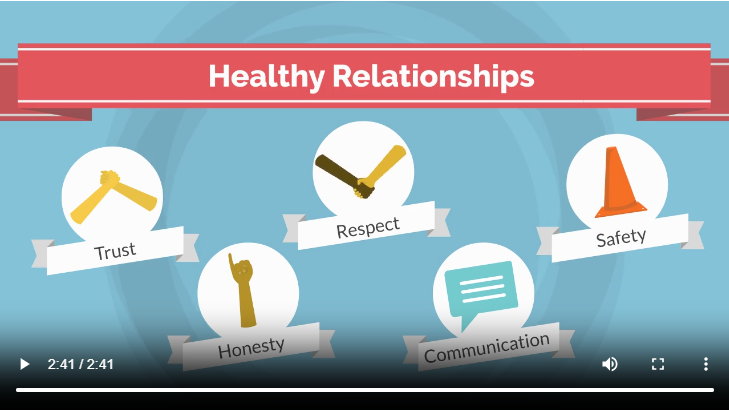 One of the program’s online lessons for fathers and teens.The next steps for Grossman and her team are to apply for funding to expand families' access to the program, evaluate its effectiveness, and adapt the program to fit different types of families, like LGBTQ+ teens and their fathers.
This study received funding from grant 1R21HD109744-01A1 from the National Institute of Child Health and Human Development.