
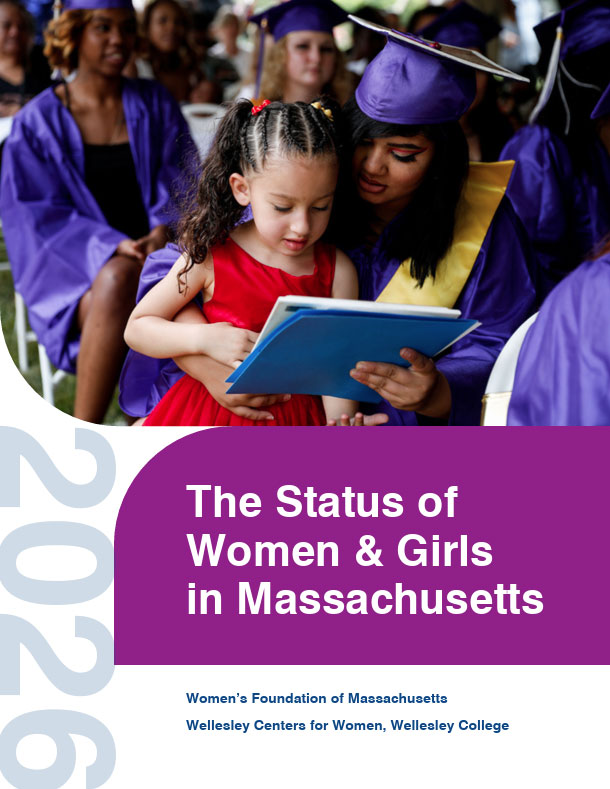
 The Wellesley Centers for Women (WCW) and the Women’s Foundation of Massachusetts (WFMA) are pleased to announce their inaugural report on the Status of Women & Girls in Massachusetts.
This comprehensive report is the first of its kind and fills a critical information gap on the wellbeing of women and girls in Massachusetts, with a particular focus on economic empowerment. It focuses on three core indicators of women’s and girls’ wellbeing, opportunity, and agency: women’s earnings and labor force participation; education pathways and outcomes; and the health of girls and women.
“Massachusetts is often celebrated for its economic strength and educational excellence, but this research reveals a more complicated reality for women and girls. Behind strong statewide rankings are persistent gender disparities in earnings, leadership representation, caregiving responsibilities, and health outcomes,” said Christina Gordon, Co-Founder and CEO of the Women’s Foundation of Massachusetts. “When women and girls do not have equitable access to opportunity, our entire economy loses potential. Philanthropy has a critical role to play. By directing meaningful, multi-year investments to organizations serving women and girls, we can close gaps that policy alone cannot solve and ensure that economic growth in Massachusetts is inclusive and sustainable.”
By many indicators, Massachusetts ranks among the strongest states in the nation for women, but these indicators mask persistent and consequential disparities. Basic economic security is out of reach for many due to factors like the gender wage gap and the high cost of living, which hit single mothers and elderly women particularly hard.
When it comes to education, Massachusetts girls have higher levels of achievement than boys, but receive unequal rewards. Though girls graduate high school and enroll in college at higher rates, they start their careers earning less and carrying more debt. And despite high levels of health insurance coverage and strong overall rankings for women’s quality of life, top-ranked health care is not everyone’s reality. Women face barriers to care and high levels of maternal mortality, and girls face high teen pregnancy rates in Gateway Cities and alarming rates of mental distress.
“This is the first time all of this data has been compiled in one place, giving us a critical big-picture understanding of what life is like for women and girls in Massachusetts,” said WCW Interim Executive Director and Senior Research Scientist Georgia Hall, Ph.D., who led the research along with WCW Senior Research Scientist and Economist Sari Pekkala Kerr, Ph.D. “Data is power, and having this information empowers us to work toward solutions to the challenges women and girls are facing.”
The report integrates original examination of publicly available datasets with findings from government-related agencies, established research institutions, and nationally recognized nonprofit organizations. It also acknowledges recent Massachusetts legislation that intersects with the lives of women and girls and may influence their economic and social outcomes in complex ways.
The overarching aim of the project is to provide ongoing, periodic updates on the status of women and girls in Massachusetts as new data become available and as emerging areas of inquiry are identified.
Read the executive summary and the full report
“At the Wellesley Centers for Women, our mission is to transform research into action,” said Kerr. “This report allows us to do just that: to use data to shape a better world for women and girls.”
Watch a recording of the report launch event, and read more about the project.

